ROSSTAT’S STATISTICS — WHAT WAS ONCE HIDDEN IS NOW OUT IN THE OPEN
Since 2022, more and more statistics have been disappearing from public access in the Russian Federation. This includes not only data on mortality, but also on migration, disability, oil production, exports and imports of specific goods, and so on. They are hiding everything that could in any way reveal the Kremlin’s failures. Now, thanks to a hack of Rosstat, we will be able to shed light on many of the secrets of Putin’s regime.

Rosstat officials keep making the same mistake as Roskomnadzor and Aeroflot after our attacks: they assert that no data breach has occurred. Let’s assist Rosstat in acknowledging the breach.😏
A Leak From Rosstat
Within six months, my colleagues at Silent Crow and and we successfully accessed approximately 25,000 computers on Rosstat’s internal network, exfiltrating terabytes of data. This breach included the agency’s primary internal systems: DPSC, STATECH, Demography, and several others. Because agency employees use these platforms to store raw, unpublished statistical data, we were able to secure the full spectrum of their internal findings.
Consequently, when discussing this significant leak, we are looking far beyond the personal data and internal documents of Rosstat employees—though we have already secured all of that information as well. Any attempt by Rosstat to deny the breach directly contradicts the reality faced by its own workforce.
The most critical intelligence retrieved consists of highly confidential statistics that the Russian Federation has systematically concealed since 2022. This includes key demographic and socioeconomic indicators that reveal the true situation within Russia and the Russian-occupied territories of Ukraine.
Processing a dataset of this magnitude will take time. To ensure maximum efficiency, together with our colleagues at Silent Crow, we are prioritising the release of Rosstat’s internal document workflow to independent media journalists. This archive comprises over 3 TB of records, including those classified as "DSP" (Dlya Sluzhebnogo Polzovaniya — for official use only).
Having analysed a preliminary portion of these files, we are providing initial examples of the insights contained within the dataset.
Reports from the Occupied Territories of Ukraine
Rosstat’s internal document workflow is a critical asset due to the comprehensive data it contains regarding Ukrainian territories currently under Russian occupation. The Putin regime meticulously suppresses this information; statistical data on these occupied regions is strictly withheld from the public and distributed only to authorised Russian federal agencies under the restrictive "DSP" (for official use only) classification. Consequently, these records provide an unprecedented, unvarnished look into the reality of life in these regions under occupation.

Among the files are expert population estimates for the occupied territories spanning several years. This data is typically compiled in standalone spreadsheets distributed as attachments to official correspondence


The archive also contains valuable, month-by-month production statistics spanning all economic sectors. For context, the document below details industrial and agricultural output in the occupied Donetsk region from January through December 2025.

The archive includes comprehensive socioeconomic indicators across all tracking sectors, granularly broken down by month and specific reporting periods. It also features detailed payroll data — including average wages and headcount metrics — both on an aggregate level and isolated by industry. This data provides critical baseline material for researchers conducting economic impact assessments.


Furthermore, the archive contains specialised datasets of significant value to niche researchers, including historical reporting on infectious disease rates within the occupied territories. We welcome inquiries from experts with an active research interest in these specific metrics. However, due to the heavy administrative workload involved in processing this data, we kindly request that you defer outreach for the next few months. We will be better positioned to accommodate data requests later in the year once our initial processing and analysis are complete.
ROSSTAT’S STATISTICS: Broader Statistical Indicators
Rosstat’s electronic document management system aggregates granular data from all territories under the jurisdiction of the Russian Federation, alongside comprehensive nationwide metrics. This repository holds significant value for researchers across a vast spectrum of fields. Crucially, a substantial portion of this data is withheld from the public domain under restricted classifications, making these internal documents and databases the sole source for this otherwise inaccessible information.

However, the document workflow does not include the full range of statistics available to the department. Most of the unpublished information is contained in databases. Statistical reports on these hidden indicators were not prepared in a format suitable for publication, as they were deemed unnecessary.
We still have to sift through these terabytes of ‘raw’ data to assess the scale of the leak in greater detail. This publication therefore focuses primarily on the document workflow, which is relatively easier to analyse.
Data on Russian Federation casualties in the war against Ukraine
One of our priorities on the Rosstat network was to extract statistics on actual mortality in the Russian Federation. Such data is not transmitted in full through the document workflow either, but is contained in a separate database within the Demography system.
This is a database containing death certificates for absolutely all Russian citizens whose deaths have been officially recorded. We obtained data covering the period from the start of the full-scale war with Ukraine up to August 2026.
As an example, we are publishing the death records for Yevgeny Prigozhin and Alexei Navalny from this database.


While we have not yet identified a dedicated, standalone Rosstat dataset tracking casualties from the hostilities, the database does contain granular cause-of-death records that allow researchers to verify when an individual died specifically in the war. For context, we have included a screenshot of a June 2023 report from the Krasnoyarsk Region Statistics Office showing exactly how these deaths are documented. We are also publishing the complete unredacted file.
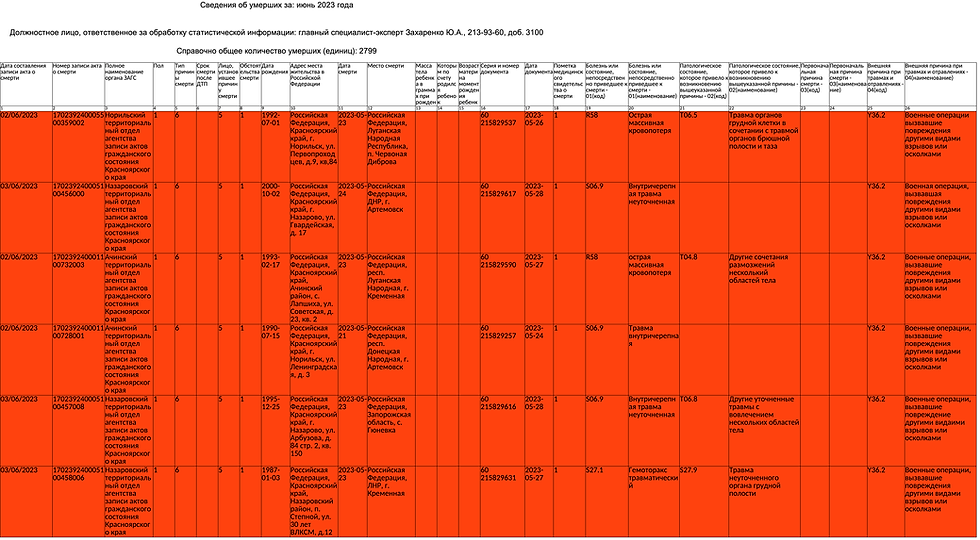
Consequently, calculating true casualty figures requires aggregating every record where the death certificate explicitly notes a fatality resulting from military hostilities. Our team has just begun this extensive data processing phase. So keep an eye on our channel for updates!
How to contact us
We are currently accepting applications from journalists from independent media organisations seeking access to Rosstat’s internal document management system, who are prepared to spend time analysing the available materials.
To submit a request, please message us via the bot for media representatives: @cpartisans_urgent_bot
❗Please note that the bot is for media representatives only, and we are not currently accepting applications from members of the public.
Concurrently, we are analysing the broader leaked Rosstat databases and will share updates regarding future data releases, collaborative investigations, and public disclosures.
Stay tuned for updates on the CyberPartisans channel and website!

